FAQs - University Gastronomy
a) Autoload
Topping up your card via Autoload can only be carried out when paying at a cash desk. That happens the moment your balance drops below the value you specified.
Should the Studierendenwerk receive a return debit note, the card will be blocked. You can unblock it at an Infopoint. Only cash can be accepted for unblocking a card after a returned payment. Should you have any questions, please contact: mensa@stwm.de.
Cards can only be automatically topped up at a cash register; unfortunately, Autoload can’t be carried out at vending machines.
In order to prevent fraud and for your own safety, your card can only be automatically topped up once a day. You will however still be able to top up your card with cash at the service machines.
Registering takes place at the Infopoints where you complete a SEPA direct debit mandate, thus authorizing us to make withdrawals from your personal or joint account. To do so, please bring along a document verifying you as the account holder (e.g. bank card, banking app, bank statement) as well as your canteen card (Legic Card / StudentCard).
Any account which we can withdraw from within the SEPA can be used. If you’re not sure whether or not your account can be used for SEPA direct debit, please get in touch with your bank to find out. In general, SEPA countries include all 27 EU states plus EEA countries Iceland, Liechtenstein and Norway as well as Switzerland, Monaco, San Marino, Andorra, Vatican City and the UK.
You’ll need to provide at least the IBAN for your account. If you have an account in Switzerland, Monaco, San Marino, Andorra, Vatican City or the UK, you’ll also require the BIC.
In order to complete the SEPA direct debit mandate you also need to provide proof of your current address, such as a valid ID showing your address. In the case of international students whose current address is not stated on their ID, we require the student’s “Meldebescheinigung” (official proof of residence).
Should your bank account, address or even your name change, please immediately inform the Infopoint.
Autoload means that new credit will be put onto your card as soon as it falls below a certain value. It’s carried out via direct debit; thus you’ll no longer need to top up your card at the service stations. You’ll always have enough credit on your card!
b) Traffic-Light Labelling – CO2e and Water Footprint
Fresh water resources are not evenly distributed around the world. 70% of fresh water resources are used for food production. The water footprint does not state the general usage of water, but relates to a region's water shortage. Food which is cultivated in arid regions increases the region's water shortage. Thus, a tomato which was grown in Germany has a different water footprint compared to a tomato which was grown in regions with less water, such as Spain.
The water footprint takes into account the amount of fresh water which is used for the product in the individual production region as well as the region's relative water shortage.
The STWM has been labelling the dishes' CO2e and water footprint by means of a traffic-light system since September 2024.
As part of the STWM's sustainability strategy, the traffic-light system were introduced in September 2024. Along with several other Studierendenwerke, our University Gastronomy was taking part in a project conducted throughout Germany; it was carried out by NAHhaft e.V. and is supported by the Federal Ministry for Economic Affairs and Climate Action as part of the national climate protection initiative.
Thus, we are also meeting with the request of the Bayerische Landesstudierendenrat for a more climate-friendly university gastronomy and are taking responsibility for our climate and environment.
The CO2e footprint of beef, pork and poultry differs in particular due to the different amounts of emissions that are set free during production. The value chain of beef leads to higher CO2e emissions than is the case with poultry and pork. This is mainly due to higher methane emissions resulting from cattle farming. Due to the high protein content, often soya is used as feed for chickens, pigs and cows. In order to meet the increasing demand for this feed, rainforest is felled for instance in Brazil (changes in land use). Compared to beef, the CO2e emissions in poultry and pork production are lower. These differences are mainly a result of the lower methane production. Despite these lower emissions, pork and poultry also lead to deforestation as large areas are needed for the production of feed, especially soya.
Comparison:
- beef: 16.6 kg CO2e / kg
- pork: 7 kg CO2e / kg
- poultry: 4.4 kg CO2e / kg
German source: NAHhaft e.V.
The following food is especially bad for the climate: a lot of animal-based food, intensely processed and cooled products as well as food whose production requires processes that are harmful to the environment.
(German source: NAHhaft e.V.).
More information in German can be found here.
A climate-friendly cuisine uses food which creates comparatively few greenhouse gas emissions while being produced – on its entire way from the field to the kitchen.
(German source: NAHhaft e.V.)
More details can be found in the German FAQs provided by NAHhaft e.V.
CO2 is carbon dioxide and only ONE of several factors which are included in the climate footprint. Apart from carbon dioxide (CO2) there are also other greenhouse gases. The total of all greenhouse gases is converted into CO2 equivalents – abbr. CO2e.
Our graphics use the simplified CO2.
Sometimes, you'll also come across the abbreviations "CO2e" or "CO2eq" for "CO2 equivalents". That tells you that the other greenhouse gases are included.
(German source: NAHhaft e.V.).
More detailed information can be found in the German FAQs provided by NAHhaft e.V.
Various different factors are considered.
In order to calculate the dishes' CO2e footprint, the ingredients' origin, transport, seasonality, convenience as well as existing certificates are taken into account. By means of a life cycle assessment the individual CO2e emissions are established.
Evaluating a dish's climate footprint requires a reference. Eaternity has analysed data provided by 150 businesses from the food-service industry for business, industry, schools, universities and health care, situated mainly in German-speaking countries. This data resulted in an average which shows whether a dish improves or increases the CO2e and water footprint compared to it.
Evaluation requires a reference. Eaternity has analysed data provided by 150 businesses from the food-service industry for business, industry, schools, universities and health care, situated mainly in German-speaking countries. This data was used to establish an average.
More information in German can be found here.
c) Most Frequent Questions
In general, you will find the various dishes' prices in the canteens or on our website.
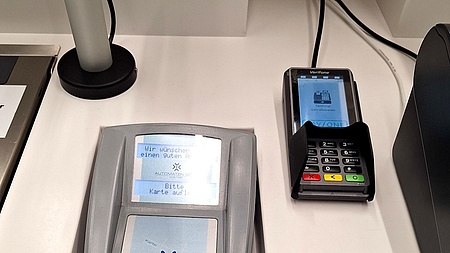
As soon as a canteen has changed to the new service and cash desk system, you will receive information from our staff at checkout. You're very welcome to turn to the management of the individual canteen or cafeteria with any questions you may have. Or send an email to mensa@stwm.de.
Due to data protection, cards are not personalized; we can therefore only block your card and give you back the remaining balance if you know your card number. So make sure to take a note of your 6-digit card number, e.g. with your phone. Should you lose your card, you can then provide your card number in order to have it blocked by the Infopoint. Also, if a card is found and handed in, the number makes it possible to verify the owner of the card and thus return it.
In most of our canteens and cafeterias dishes are available via a self-service system. You thus determine the size of your meal yourself and pay according to weight. In the case of meat and fish dishes (as well as with asparagus) an additional fixed price is charged ("Festpreiskomponente"). These additional charges are stated in the pricing.
In some of our canteens, such as the Lothstraße Canteen or the Weihenstephan Canteen, our dishes are not charged per weight but per portion.
All our gastronomic services which have already switched to our new service and cash desk system now offer desserts in a glass. Desserts are also offered in plastic cups as this makes it possible to present them a lot more attractively as would be the case in porcelain bowls. Another advantage is the possibility to buy them as a takeaway for later, which a lot of our students like doing.
We frequently look into the possibility of donating food, which is, however, not as simple as one might presume; often, certain conditions need to be fulfilled, such as assumption of liability. Donating food is therefore unfortunately not possible at the moment. However, the Studierendenwerk always does its best to generally avoid food waste.
The Studierendenwerk doesn’t set up water dispensers for hygienic reasons. However, the Sodenthaler StuCafé water is available for only 50 cents per half a litre in all of the Studierendenwerk’s gastronomic facilities.
In the case of meals that are sold in fixed amounts that’s unfortunately not possible as the dishes and their prices are worked out in detail. But you’re always welcome to buy yourself a second helping. A further reason why we are introducing self-service concepts – everyone can take exactly as much as they want. Getting yourself more, is then always possible.
Unfortunately, the fresh milk was often drunk “just like that” without any coffee. That led to our employees hardly being able to keep up with filling up the milk; often, there was none left for our coffee drinkers, causing complaints. We are sorry to say that putting up notices has so far shown no results, which is why you can only get portioned milk at some of our coffee machines.
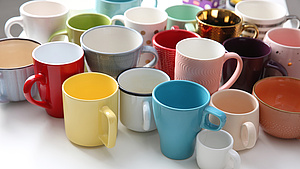
The Studierendenwerk offers its customers various possibilities to avoid using paper cups. For one thing, it is of course possible to use porcelain cups to enjoy your cup of coffee. The Studierendenwerk also offers reusable cups to go, which are available in our StuCafés and StuBistrosMensa. Naturally, all our customers can also bring and use their own cups from home. We have also initiated the project Cupsharing. Anyone can hand in cups and mugs, which they no longer need at home, at the participating cafeterias. And if you don't have a cup with you, you can borrow one from the cup pool and hand it back later.
The outlet at the coffee machines can be adjusted in height.
Our University Catering Service is available for customers in the field of higher education; it’s part of the department University Gastronomy of the Studierendenwerk München Oberbayern.
There’s a central menu, which is created a lot in advance. Individual dishes however are put on the menus by our facilities’ chefs on that day. This ensures flexibility. Only the menu planned up ahead is available online, which currently cannot be brought up to date immediately should, for instance, food run out or should there be delivery problems. We’re already working hard at soon being able to provide more detailed information.
Here we have good news. The nutritional values of the listed articles are by and by being entered into the management system. That’s a lot of work as several thousand articles need to be edited in our data base. We’re nonetheless glad to carry out this task. Nutritional values have already been entered for a majority of the articles, so that our guests will soon be able to gain access to this information. We’re planning to publish this data for the coming winter semester.
Several weeks go by from putting together the menu to ordering the food and it being delivered and processed. During this time it can happen that articles are altered by the producer or supplier. This information is then of course passed on to our guests. For instance, the ingredients of our noodles changed, making it necessary to change the labelling from “vegan” to “vegetarian”.
For the most part, our canteens don’t use flavour enhancers that require labelling (in accordance with the German “Zusatzstoff-Zulassungsverordnung”) as ingredients for their recipes, such as monosodium glutamate. We also, as far as possible, don’t offer any products which contain them. Dishes or products that do contain them are labelled with the corresponding number (4).
Our chips naturally don’t contain any ingredients of animal origin, but consist solely of potatoes and oil. They’re also always deep-fried in vegetable fat. However, the deep fryer is also used for other food that does contain meat. Unfortunately, our canteens don’t have a sufficient number of deep fryers to strictly separate the different types of food and it’s not possible to keep changing the frying fat as we’re talking about up to 160 litres which would have to be changed a couple of times each day.